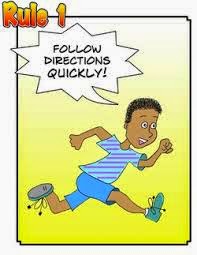
At the beginning of the year, teachers should decide classroom rules according to to the students' ages and levels. Eveything should be clear. Students should know what is acceptable and not acceptable. Rules should be short and inclusive, comprehensive. For example; one of my rule is " Make smart choices" which includes so many behaviours in it. After that, you should decide punishments and awards in the class. They should keep in their mind if they obey the rules, they are going to get awards and if not, they will get punished.
I decided to use SuperImproviser( Scoreboard) which is from WholeBrainTeaching.
First two weeks, you suffer to teach the rules but, after two weeks, everything runs well in the classroom. Students take pleasure of it also teachers as well.
Decide your criterions and give them stars according to them. Every ten stars, they level up. Every level up give them some awards.
I started using that scoreboard this year. Off task students are getting less day by day.
If you want, I can send you whole pack of this scoreboard with colored worksheets.
We know that yelling and scolding doesn't work any more. Schools are dangerous places. According to the National Center for Education statistics, in 2007 there were "1.5 million victims of non fatal crimes at school.The behavior of challenging kids cannot be imroved by heavier doses of punishment. Punishment makes them more rebellious. Most challenging kids genuinely want to be part of the classroom environment ;this is why they work so hard to get everyone's attention. Kids want to laugh and play Whole Brain Teaching produces classrooms that are full of orderly fun.
Here is the WBT's secret: if a student's whole brain is involved in learning, there isn't any mental area left over for challenging kids.
1) Class-Yesinvolves the prefrontal cortex, the reasoning center of the brain. Think of this area as a " light switch" that must be turned on for the rest of the brain to process information. This is an attention gather.
3) Teach - Okay WBrain Teachers have discovered that disclining yourself to speak in units that are 30 seconds or less and then having your students repeat your message to each other. You present a few points; your students repeat them to each other ; you present a few more. In the little preiods when students are talking, you take mini breaks to organize your thoughts for your next few sentences. WB Teachers call this MICRO-LECTURING.
4)The Scoreboard According to students' performance, teachers put a point under frowny or smiley faces.WBTeachers know that students should never have 3 more frownies than smilies or vice versa. Students shouldn't be punished or rewarded too too much. At the end of the week Reward: one minute more of recess. This gave them a taste of success. Never reward or penalized more than two or three minutes of recess.
5) Hands and Eyes 6) Mirror : Mirror is one of WBT's simplest and most powerful techniques. You say " mirror" and your students respond "mirror". They then pick up their hands ready to mimic your gestures. Use mirror when telling a story, giving directions, describing the steps in a procedure, demonstrating a process
These are basic principles of Whole Brain Teaching. There are also activities related to the WBT. I will keep blogging.
You can watch the video and see Hands and Eyes, Mirror under the Teach - Okay
There are many more videos and you can learn more about WBT. I've just summarized. You can watch and learn more from here