Raz-Kids is a website that includes hundreds of leveled ebooks with e-quizzes. . Students have to listen to the books first, then read them and lastly record their voices. Online Records let teachers digitally assess each student, saving valuable classroom time. All books are available 24/7 via the Web. Students can practice reading anytime, anywhere. Teachers can make assignments and track student progress with online assessments and student recordings. Viewing reports is simple, for individuals, classrooms, schools and even districts!
In my school, we have subscriptions for each of the students. Every week Ss read one book at home and one book in the class. Ss improved their reading and vocabulary a lot via that website. I highly suggest you to use raz-kids. The only problem is that it is not free but, the fee is affordable. It is worth it.
This app lets you create amazing classroom communities with students and parents. Teachers can communicate with parents and students privately- no need to exchange phone numbers. You can give feedback to students for any skill like "Working Hard" and "Being Respectful". Students also can share their works. Teachers can get parents involved by sharing photos and videos of wonderful classroom moments. I personally as a teacher use this app and I saw that everything gets easier. Parents and students can check everything about the lessons.
I think teachers should use a checklist to see students behaviours, notes, attitudes etc. weekly. The one I shared with you is my checklist. Every week I fill the checklist according to my criterias. One can follow students' progress with this checklist also Ts can show this to parents in the P.meeting, which will be easier to explain them students' performance in the classroom.
RUBRICS:
A)Creativity in personal work; Participation in the
lesson; Contributions to the lesson; Co-operation in groups or pairs;
Completing tasks and assignments in
time: high (3) , medium (2), low (1)
B)Interruptive and distractive behaviour in the
class; Positive behaviour in the class;
very often (5); often (4); sometimes (3); rarely(2); never (1)
C) attitude towards the teacher; Attitude towards peers:
very positive (3); neutral (2); bad (3); very bad (4)
D)Weekly
homework flow: Neat and regular (3); not so neat and regular (2); never does
(1)
First 5 minutes of the lesson is really important. Teachers need to get students attention and make a intriguing start. Reflect all your energy to students!! This video is from my lesson. I tried to relax students and get their attention at the beginning of the lesson...
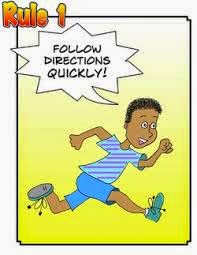
At the beginning of the year, teachers should decide classroom rules according to to the students' ages and levels. Eveything should be clear. Students should know what is acceptable and not acceptable. Rules should be short and inclusive, comprehensive. For example; one of my rule is " Make smart choices" which includes so many behaviours in it. After that, you should decide punishments and awards in the class. They should keep in their mind if they obey the rules, they are going to get awards and if not, they will get punished.
I decided to use SuperImproviser( Scoreboard) which is from WholeBrainTeaching.
First two weeks, you suffer to teach the rules but, after two weeks, everything runs well in the classroom. Students take pleasure of it also teachers as well.
Decide your criterions and give them stars according to them. Every ten stars, they level up. Every level up give them some awards.
I started using that scoreboard this year. Off task students are getting less day by day.
If you want, I can send you whole pack of this scoreboard with colored worksheets.
The main purpose of rubrics is to assess performances.
Good writing is a complex accomplishment involving the organization of ideas, the select use of vocabulary, attention to readers and purpose, and the "mechanics" of grammar, spelling, punctuation and handwriting.
Rubrics provide information about the qualities and dimensions of good writing and feedback about their progress. The genius of rubrics is that they are descriptive and not evaluative.
I'm going to share a couple of rubrics for you. You can choose one according to your purpose.
If you have internet access in the classroom, show your students this video in which they can see how to make a simple 8-page book from a single piece of paper. It is very fun for beginning writers and readers to make their own little book.Your students can make their picture books using that
Yesterday, I was in the 1st Undergraduate ELT Conference which was organized by Elt Student Council in Marmara University. I am also in the Marmara University as a pre-service teacher. This conference was completely arranged by pre-service teachers. Volunteer students made presentations in some topics such as differentiated instruction, motivation, student autonomy. There were also some teacher trainers and instructors as a presenter, which give us a chance to see different points, views, methods. Especially, the presentation "21st Century Teachers" affected me deeply since the world is changing and the technology is improving so fast. We've to catch up innovations. To sum up, everybody is complaining about something in education.We should just leave talking and complaining and do something useful. This conference was the good example for us. If we want to change something and live up to 21st century's expectations, we need these activities in every university. I believe the students in this conference will be the best teachers in Turkey. I want to thank my friends for this organization.
We know that yelling and scolding doesn't work any more. Schools are dangerous places. According to the National Center for Education statistics, in 2007 there were "1.5 million victims of non fatal crimes at school.The behavior of challenging kids cannot be imroved by heavier doses of punishment. Punishment makes them more rebellious. Most challenging kids genuinely want to be part of the classroom environment ;this is why they work so hard to get everyone's attention. Kids want to laugh and play Whole Brain Teaching produces classrooms that are full of orderly fun.
Here is the WBT's secret: if a student's whole brain is involved in learning, there isn't any mental area left over for challenging kids.
1) Class-Yesinvolves the prefrontal cortex, the reasoning center of the brain. Think of this area as a " light switch" that must be turned on for the rest of the brain to process information. This is an attention gather.
3) Teach - Okay WBrain Teachers have discovered that disclining yourself to speak in units that are 30 seconds or less and then having your students repeat your message to each other. You present a few points; your students repeat them to each other ; you present a few more. In the little preiods when students are talking, you take mini breaks to organize your thoughts for your next few sentences. WB Teachers call this MICRO-LECTURING.
4)The Scoreboard According to students' performance, teachers put a point under frowny or smiley faces.WBTeachers know that students should never have 3 more frownies than smilies or vice versa. Students shouldn't be punished or rewarded too too much. At the end of the week Reward: one minute more of recess. This gave them a taste of success. Never reward or penalized more than two or three minutes of recess.
5) Hands and Eyes 6) Mirror : Mirror is one of WBT's simplest and most powerful techniques. You say " mirror" and your students respond "mirror". They then pick up their hands ready to mimic your gestures. Use mirror when telling a story, giving directions, describing the steps in a procedure, demonstrating a process
These are basic principles of Whole Brain Teaching. There are also activities related to the WBT. I will keep blogging.
You can watch the video and see Hands and Eyes, Mirror under the Teach - Okay
There are many more videos and you can learn more about WBT. I've just summarized. You can watch and learn more from here